

Article Sidebar
Downloads
Main Article Content
Abstract
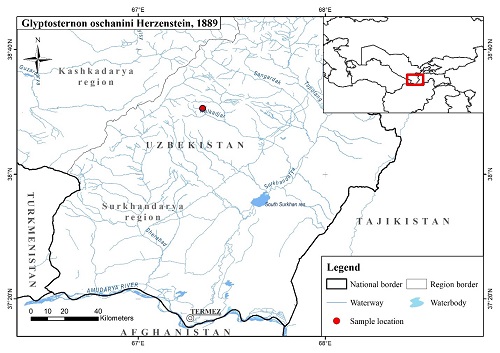
This study first examined the external morphology and molecular-genetic characteristics of the Turkestan catfish Glyptosternon oschanini from the Khojaipak River (Surkhandarya basin, Uzbekistan) using combined morphometric and DNA barcoding approaches. Specimens (n=14) were collected in the upper reaches of the Khojaipak River in 2023-2024 and examined for meristic and plastic characters following standard ichthyological methods. The fish is characterized by the following meristic features: dorsal fin rays I 6, anal fin rays III 5, pectoral fin rays I 10, pelvic fin rays I 5, 10 gill rakers on the first gill arch, and 33 vertebrae. The body is naked and low; the head is flat with small eyes; the mouth is lower; and four pairs of barbels are present on the snout. Most plastic (morphometric) features showed low variability, with coefficients of variation ranging from 0.82% to 10.68% relative to standard length and from 3.78% to 12.70% relative to head length; the eye diameter was the most variable character in both cases. For the molecular component, the mitochondrial cytochrome oxidase I (COI) gene was amplified, sequenced, and compared with 21 GenBank sequences of Glyptosternon species, using G. andersoni as an outgroup. Maximum Likelihood and Bayesian Inference resolved three well-supported clades: a G. reticulatum/G. maculatum clade (bootstrap 98%), a G. oschanini clade including the Uzbek samples (bootstrap 94%), and a clade composed exclusively of Glyptosternon sp. accessions (bootstrap 94%). The Uzbek G. oschanini sample showed the smallest genetic distance to other G. oschanini sequences (0.0143-0.0195) and to the Glyptosternon sp. group (0.00477), but was clearly divergent from G. reticulatum (0.0822-0.0887) and from the outgroup G. andersoni (0.1439). These results confirm G. oschanini as a species distinct from G. reticulatum and indicate a close phylogenetic relationship with the unidentified Glyptosternon sp. lineage, whose taxonomic status requires further revision. The study demonstrates that the COI gene is an effective molecular marker for species-level discrimination within the genus Glyptosternon and provides new morphological and genetic baseline data for G. oschanini populations in Uzbekistan.
Keywords
Article Details

This work is licensed under a Creative Commons Attribution-NonCommercial-NoDerivatives 4.0 International License.
The authors transfer the copyrights of their papers to the Iranian Society of Ichthyology. However, the information could be used in accordance with the Creative Commons licence (Attribution-NonCommercial 4.0 International (CC BY-NC 4.0)
References
- Amanov, A.A. 1985. Ecology of fish in reservoirs of the south of Uzbekistan and adjacent republics. – Tashkent: Fan. – 160 p. (In Russian)
- April, J.; Mayden, R.L.; Hanner, R.H. & Bernatchez, L. 2011. Genetic calibration of species diversity among North America’s freshwater fishes. Proceedings of the National Academy of Sciences 108(26): 10602-10607.
- Berg, L.S. 1949. Freshwater fishes of the USSR and adjacent countries. M.-L.: Publ. USSR Academy of Sciences. Part 2. P.467-926. (In Russian)
- Coad, B.W. 1981. Fishes of Afghanistan, An Annotated Checklist. National Museum of Natural Sciences (Canada) 14, i–v + 1-26.
- Eschmeyer, W.N. 1998. Catalog of Fishes. Center for Biodiversity Research and Information, Spec. Publ. 1. California Academy of Sciences. Vols. 1-3: – P.1-2905.
- Felsenstein, J. 1985. Confidence limits on phylogenies: An approach using the bootstrap. Evolution 39(4): 783-791.
- Hall, T. A. 1999. BioEdit: a user-friendly biological sequence alignment editor and analysis program for Windows 95/98/NT. Nucleic Acids Symposium Series 41: 95-98.
- Hebert, P.D.N.; Cywinska, A.; Ball, S.L. & deWaard, J.R. 2003. Biological identifications through DNA barcodes. Proceedings of the Royal Society of London. Series B: Biological Sciences 270(1512): 313-321.
- Hora, S.L. 1932. Glyptosternum reticulatum McClelland, a siluroid fish from Afghanistan. Annals and Magazine of Natural History (Series 10) 10. – P. 176-179.
- Huelsenbeck, J.P. & Hillis, D.M. 1993. Success of phylogenetic methods in the four-taxon case. Systematic Biology 42(3): 247-264.
- Huelsenbeck, J.P. & Ronquist, F. 2001. MRBAYES: Bayesian inference of phylogenetic trees. Bioinformatics 17(8): 754-755.
- Jayaram, K.C. 1999. The Fresh Water Fishes of the Indian Region. Narendra Publishing House, Delhi. – 551 pp., pls. 1-18.
- Kalyaanamoorthy, S.; Minh, B.Q.; Wong, T.K.F.; von Haeseler, A. & Jermiin, L.S. 2017. ModelFinder: Fast model selection for accurate phylogenetic estimates. Nature Methods 14(6): 587-589.
- Karimov, B. 2020. Glyptosternon oschanini. The IUCN Red List of Threatened Species 2020: e.T169837826A169837859. www.iucnredlist.org (accessed 16 November 2026)
- Katoh, K.; Misawa, K.; Kuma, K. & Miyata, T. 2002. MAFFT: a novel method for rapid multiple sequence alignment based on fast Fourier transform. Nucleic Acids Research 30(14): 3059-3066.
- Lakin, G.F. 1990. Biometry. Textbook for biological specialty universities. 4th ed. M.: Higher. School. 352 p. (In Russian)
- Letunic, I. & Bork, P. 2021. Interactive Tree of Life (iTOL) v5: An online tool for phylogenetic tree display and annotation. Nucleic Acids Research 49(W1): W293-W296.
- McClelland, J. 1842. On the fresh-water fishes collected by William Griffith, Esq., F.L.S. Madras Medical Service, during his travels under the orders of the Supreme Government of India, from 1835 to 1842. // Calcutta Journal of Natural History 2(8): 560-589.
- Minh, B.Q.; Schmidt, H.A.; Chernomor, O.; Schrempf, D.; Woodhams, M.; Von Haeseler, A. & Lanfear, R. (2020). IQ-TREE 2: New models and efficient methods for phylogenetic inference in the genomic era. Molecular Biology and Evolution 37(5): 1530-1534.
- Mirzayev, U.T. 2019. Turkestan catfish Glyptosternon oschanini Herzenstein, 1889. In: Azimov, D.A. (Ed.), The Red Data Book of the Republic of Uzbekistan. Volume II: Animals. Chinor ENK, Tashkent. p. 118.
- Ng, H.H. 2003. A revision of the south Asian catfish Sisor (Teleostei: Siluriformes). Journal of Natural History 37: 2871-2883.
- Ng, H.H. & Kottelat, M. 2000. Descriptions of Three new species of catfishes (Teleostei: Akysidae and Sisoridae) from Laos and Vietnam. Journal of South Asian Natural History 5: 7-15.
- Pravdin, I.F. 1966. Guide to fish study. 4th ed. M.: Food industry. 376 p. (In Russian)
- Thoni, R.J.; Simonov, E.; Artaev, O.; Asylbaeva, Sh.; Aibek, S.U. & Levin, B.A. 2017. A century in synonymy: molecular and morphological evidence for the revalidation of Glyptosternon osсhanini (Herzenstein, 1889) (Actinopterygii: Sisoridae), Zootaxa. 4277(3): 435-442.
- Wai, C.Y.Y.; Leung, N.Y.H.; Leung, A.S.Y.; Tang, M.F.; Marknell DeWitt, Å.; Rosa Duque, J.S.; Chua, G.T.; Yau, Y.S.; Chan, W.H.; Ho, P.K.; Kwan, M.Y.W.; Lee, Q.U.; Wong, J.S.C.; Lam, I.C.S.; Cheng, J.W.C.H.; Luk, D.C.K.; Liu, Z.; Ngai, N.A.; Chan, O.M.; Leung, P.S.C.; Wong, G.W.K. & Leung, T.F. 2025. Fish Allergenicity Ladder and Parvalbumin Epitopes for Predicting Clinical Cross-Reactivity and Reintroduction in Chinese Population. Allergy 2025: 1-14
- Ward, R.D.; Zemlak, T.S.; Innes, B.H.; Last, P.R. & Hebert, P.D.N. 2005. DNA barcoding Australia’s fish species. Philosophical Transactions of the Royal Society B: Biological Sciences 360(1462): 1847-1857.
- Zinoviev, E.A. & Mandritsa, S.A. 2003. Methods of freshwater fish research: Textbook for a special course. Perm: Perm University. 113 p. (In Russian)
References
Amanov, A.A. 1985. Ecology of fish in reservoirs of the south of Uzbekistan and adjacent republics. – Tashkent: Fan. – 160 p. (In Russian)
April, J.; Mayden, R.L.; Hanner, R.H. & Bernatchez, L. 2011. Genetic calibration of species diversity among North America’s freshwater fishes. Proceedings of the National Academy of Sciences 108(26): 10602-10607.
Berg, L.S. 1949. Freshwater fishes of the USSR and adjacent countries. M.-L.: Publ. USSR Academy of Sciences. Part 2. P.467-926. (In Russian)
Coad, B.W. 1981. Fishes of Afghanistan, An Annotated Checklist. National Museum of Natural Sciences (Canada) 14, i–v + 1-26.
Eschmeyer, W.N. 1998. Catalog of Fishes. Center for Biodiversity Research and Information, Spec. Publ. 1. California Academy of Sciences. Vols. 1-3: – P.1-2905.
Felsenstein, J. 1985. Confidence limits on phylogenies: An approach using the bootstrap. Evolution 39(4): 783-791.
Hall, T. A. 1999. BioEdit: a user-friendly biological sequence alignment editor and analysis program for Windows 95/98/NT. Nucleic Acids Symposium Series 41: 95-98.
Hebert, P.D.N.; Cywinska, A.; Ball, S.L. & deWaard, J.R. 2003. Biological identifications through DNA barcodes. Proceedings of the Royal Society of London. Series B: Biological Sciences 270(1512): 313-321.
Hora, S.L. 1932. Glyptosternum reticulatum McClelland, a siluroid fish from Afghanistan. Annals and Magazine of Natural History (Series 10) 10. – P. 176-179.
Huelsenbeck, J.P. & Hillis, D.M. 1993. Success of phylogenetic methods in the four-taxon case. Systematic Biology 42(3): 247-264.
Huelsenbeck, J.P. & Ronquist, F. 2001. MRBAYES: Bayesian inference of phylogenetic trees. Bioinformatics 17(8): 754-755.
Jayaram, K.C. 1999. The Fresh Water Fishes of the Indian Region. Narendra Publishing House, Delhi. – 551 pp., pls. 1-18.
Kalyaanamoorthy, S.; Minh, B.Q.; Wong, T.K.F.; von Haeseler, A. & Jermiin, L.S. 2017. ModelFinder: Fast model selection for accurate phylogenetic estimates. Nature Methods 14(6): 587-589.
Karimov, B. 2020. Glyptosternon oschanini. The IUCN Red List of Threatened Species 2020: e.T169837826A169837859. www.iucnredlist.org (accessed 16 November 2026)
Katoh, K.; Misawa, K.; Kuma, K. & Miyata, T. 2002. MAFFT: a novel method for rapid multiple sequence alignment based on fast Fourier transform. Nucleic Acids Research 30(14): 3059-3066.
Lakin, G.F. 1990. Biometry. Textbook for biological specialty universities. 4th ed. M.: Higher. School. 352 p. (In Russian)
Letunic, I. & Bork, P. 2021. Interactive Tree of Life (iTOL) v5: An online tool for phylogenetic tree display and annotation. Nucleic Acids Research 49(W1): W293-W296.
McClelland, J. 1842. On the fresh-water fishes collected by William Griffith, Esq., F.L.S. Madras Medical Service, during his travels under the orders of the Supreme Government of India, from 1835 to 1842. // Calcutta Journal of Natural History 2(8): 560-589.
Minh, B.Q.; Schmidt, H.A.; Chernomor, O.; Schrempf, D.; Woodhams, M.; Von Haeseler, A. & Lanfear, R. (2020). IQ-TREE 2: New models and efficient methods for phylogenetic inference in the genomic era. Molecular Biology and Evolution 37(5): 1530-1534.
Mirzayev, U.T. 2019. Turkestan catfish Glyptosternon oschanini Herzenstein, 1889. In: Azimov, D.A. (Ed.), The Red Data Book of the Republic of Uzbekistan. Volume II: Animals. Chinor ENK, Tashkent. p. 118.
Ng, H.H. 2003. A revision of the south Asian catfish Sisor (Teleostei: Siluriformes). Journal of Natural History 37: 2871-2883.
Ng, H.H. & Kottelat, M. 2000. Descriptions of Three new species of catfishes (Teleostei: Akysidae and Sisoridae) from Laos and Vietnam. Journal of South Asian Natural History 5: 7-15.
Pravdin, I.F. 1966. Guide to fish study. 4th ed. M.: Food industry. 376 p. (In Russian)
Thoni, R.J.; Simonov, E.; Artaev, O.; Asylbaeva, Sh.; Aibek, S.U. & Levin, B.A. 2017. A century in synonymy: molecular and morphological evidence for the revalidation of Glyptosternon osсhanini (Herzenstein, 1889) (Actinopterygii: Sisoridae), Zootaxa. 4277(3): 435-442.
Wai, C.Y.Y.; Leung, N.Y.H.; Leung, A.S.Y.; Tang, M.F.; Marknell DeWitt, Å.; Rosa Duque, J.S.; Chua, G.T.; Yau, Y.S.; Chan, W.H.; Ho, P.K.; Kwan, M.Y.W.; Lee, Q.U.; Wong, J.S.C.; Lam, I.C.S.; Cheng, J.W.C.H.; Luk, D.C.K.; Liu, Z.; Ngai, N.A.; Chan, O.M.; Leung, P.S.C.; Wong, G.W.K. & Leung, T.F. 2025. Fish Allergenicity Ladder and Parvalbumin Epitopes for Predicting Clinical Cross-Reactivity and Reintroduction in Chinese Population. Allergy 2025: 1-14
Ward, R.D.; Zemlak, T.S.; Innes, B.H.; Last, P.R. & Hebert, P.D.N. 2005. DNA barcoding Australia’s fish species. Philosophical Transactions of the Royal Society B: Biological Sciences 360(1462): 1847-1857.
Zinoviev, E.A. & Mandritsa, S.A. 2003. Methods of freshwater fish research: Textbook for a special course. Perm: Perm University. 113 p. (In Russian)