

Article Sidebar
Downloads
Main Article Content
Abstract
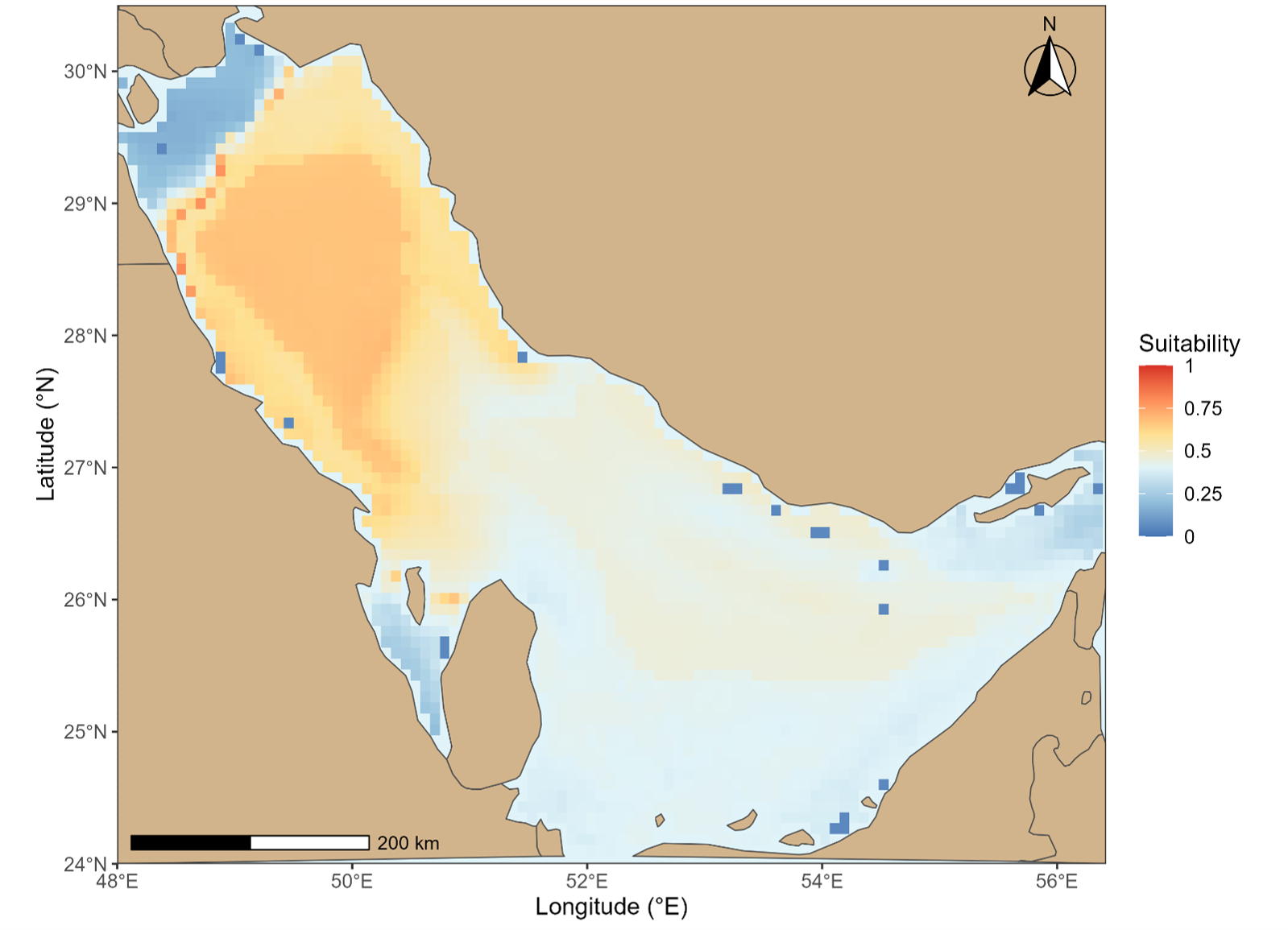
Understanding the impacts of climate change on marine habitats is essential for predicting future species distribution patterns and supporting sustainable fisheries management, particularly for commercially important apex predators. In this study, we used occurrence records from global databases (GBIF and OBIS) and published field surveys, combined with Bio-ORACLE environmental predictors, to model current and future habitat suitability of Caranx ignobilis (Forsskål, 1775) in the Persian Gulf. We implemented six individual modeling algorithms and three ensemble modeling techniques using the biomod2 platform. The ensemble model EMwmean (AUC= 0.992, TSS= 0.923) was selected for final projections because it integrates multiple algorithms and reduces model-specific bias. Based on variable importance analysis, sea surface temperature (SST), salinity, and primary production were identified as the most influential environmental predictors shaping habitat suitability. Future projections under SSP2-4.5 and SSP5-8.5 indicated progressive contraction of suitable habitat in the southeastern Persian Gulf, accompanied by a northwestward displacement of the habitat centroid. Specifically, the modelled area classified as suitable habitat is projected to decline from 48.49×10³km² under current conditions to zero by the 2090s under both SSP2-4.5 and SSP5-8.5, reflecting zero modelled suitable habitat under the applied threshold rather than biological extirpation. These findings provide spatially explicit information to support adaptive fisheries management and conservation planning, thereby enhancing the long-term resilience of this ecologically and commercially important reef-associated predator under future climate change in the Persian Gulf.
Keywords
Article Details

This work is licensed under a Creative Commons Attribution-NonCommercial-NoDerivatives 4.0 International License.
The authors transfer the copyrights of their papers to the Iranian Society of Ichthyology. However, the information could be used in accordance with the Creative Commons licence (Attribution-NonCommercial 4.0 International (CC BY-NC 4.0)
References
- Ahmadi, A.; Imanpour Namin, J.; Sharifian, S. & Daliri, M. 2023. Habitat suitability projections for the Black Pomfret (Parastromateus niger) under climate change: an ensemble modeling approach. Iranian Journal of Ichthyology 10(4): 215-224.
- Aiello-Lammens, M.E.; Boria, R.A.; Radosavljevic, A.; Vilela, B. & Anderson, R.P. 2015. spThin: an R package for spatial thinning of species occurrence records for use in ecological niche models. Ecography 38(5): 541-545.
- Alawad, K.A.; Al-Subhi, A.M.; Alsaafani, M.A. & Alraddadi, T.M. 2023. What causes the Arabian Gulf significant summer sea surface temperature warming trend?. Atmosphere 14(3): 586.
- Allouche, O.; Tsoar, A. & Kadmon, R. 2006. Assessing the accuracy of species distribution models: prevalence, Kappa and the True Skill Statistic (TSS). Journal of Applied Ecology 43(6): 1223-1232.
- Araújo, M.B. & New, M. 2007. Ensemble forecasting of species distributions. Trends in Ecology & Evolution 22(1): 42-47.
- Assis, J.; Fernández Bejarano, S.J.; Salazar, V.W.; Schepers, L.; Gouvêa, L.; Fragkopoulou, E.; Leclercq, F.; Vanhoorne, B.; Tyberghein, L.; Serrão, E.A.; Verbruggen, H. & De Clerck, O. 2024. Bio-ORACLE v3.0: pushing marine data layers to the CMIP6 earth system models of climate change research. Global Ecology and Biogeography 33: e13897.
- Barbet-Massin, M.; Jiguet, F.; Albert, C.H. & Thuiller, W. 2012. Selecting pseudo-absences for species distribution models: how, where and how many?. Methods in Ecology and Evolution 3(2): 327-338.
- Bordbar, M.H.; Nasrolahi, A.; Lorenz, M.; Moghaddam, S. & Burchard, H. 2024. The Persian Gulf and Oman Sea: climate variability and trends inferred from satellite observations. Estuarine, Coastal and Shelf Science 296: 108588.
- Boyce, D.G.; Tittensor, D.P.; Garilao, C.; Henson, S.; Kaschner, K.; Kesner-Reyes, K.; Pigot, A.; Reyes, R.B.; Reygondeau, G.; Schleit, K.E.; Shackell, N.L.; Sorongon-Yap, P. & Worm, B. 2022. A climate risk index for marine life. Nature Climate Change 12: 854-862.
- Brunner, A.; Marquez, J.R.G. & Domisch, S. 2024. Downscaling future land cover scenarios for freshwater fish distribution models under climate change. Limnologica 104: 126139.
- Buchanan, J.R.; Ralph, G.M.; Krupp, F.; Harwell, H.; Abdallah, M.; Abdulqader, E.; Al-Husaini, M.; Bishop, J.M.; Burt, J.A.; Choat, J.H. & Collette, B.B. 2019. Regional extinction risks for marine bony fishes occurring in the Persian/Arabian Gulf. Biological Conservation 230: 10-19.
- Buchholz, R.; Banusiewicz, J.D.; Burgess, S.; Crocker-Buta, S.; Eveland, L. & Fuller, L. 2019. Behavioural research priorities for the study of animal response to climate change. Animal Behavior 150: 127-137.
- Cai, W.; Santoso, A.; Collins, M.; Dewitte, B.; Karamperidou, C.; Kug, J.-S.; Lengaigne, M.; McPhaden, M.J.; Stuecker, M.F. & Taschetto, A.S. 2021. Changing El Niño–Southern oscillation in a warming climate. Nature Reviews Earth & Environment 2(9): 628-644.
- Chamberlain, S.A. & Boettiger, C. 2017. R, Python, and Ruby clients for GBIF species occurrence data. PeerJ Preprints e3304v1.
- Chen, Y.; Shan, X.; Gorfine, H.; Dai, F.; Wu, Q.; Yang, T.; Shi, Y. & Jin, X. 2023. Ensemble projections of fish distribution in response to climate changes in the yellow and Bohai seas. China. Ecological Indicators 146: 109759.
- Chen, Y.; Shan, X.; Ovando, D.; Yang, T.; Dai, F. & Jin, X. 2021. Predicting current and future global distribution of black rockfish (Sebastes schlegelii) under changing climate. Ecological Indicators 128: 107799.
- Cheung, W.W.L.; Brodeur, R.D.; Okey, T.A. & Pauly, D. 2015. Projecting future changes in distributions of pelagic fish species of Northeast Pacific shelf seas. Progress in Oceanography 130: 19-31.
- Chiang, W.C.; Lin, S.J.; Soong, K.Y.; Liao, T.Y.; Chen, Y.Y.; Ho, Y.S. & Musyl, M.K. 2023. Movement patterns and habitat use of adult giant trevally (Caranx ignobilis) in the South China Sea. Marine Biology 170: 65.
- Copernicus Climate Change Service (C3S). 2024. Global climate highlights 2024. https://climate.copernicus.eu/global-climate-highlights-2024
- Daly, R.; Filmalter, J.D.; Daly, C.A.K.; Bennett, R.H.M.; Pereira, A.M.; Mann, B.Q.; Dunlop, S.W. & Cowley, P.D. 2019. Acoustic telemetry reveals multi-seasonal spatiotemporal dynamics of a giant trevally Caranx ignobilis aggregation. Marine Ecology Progress Series 621: 185-197.
- Dehghan Madiseh, S. 1998. Identification and density determination of ichthyoplankton in Khuzestan creeks. Khuzestan Fisheries Research Center, Ahvaz.
- Dehghan Madiseh, S. 1999. Diversity and abundance of ichthyoplankton (fish larval stages) in the western coasts of Khuzestan. Khuzestan Fisheries Research Center, Ahvaz.
- Dehghan Madiseh, S. 2002. Diversity and abundance of ichthyoplankton (fish larval stages) in Khuzestan province waters - Phase 3: Eastern coasts. Khuzestan Fisheries Research Center, Ahvaz.
- Eagderi, S.; Mouludi-Saleh, A.; Fricke, R.; Alavi-Yeganeh, M.S.; Mousavi-Sabet, H. & Cicek, E. 2026. Fishes of the Sea of Oman. Iranian Journal of Ichthyology 13(Special Issue): 1-152.
- FAO. 2018. The state of world fisheries and aquaculture 2018 – meeting the sustainable development goals. Rome. http://www.fao.org/3/I9540EN/i9540en.pdf
- Froese, R.; Pauly, D. 2024. FishBase: world wide web electronic publication. www.fishbase.org, version (02/2024). (web resource). fishbase.se
- Gregorich, M.; Strohmaier, S.; Dunkler, D. & Heinze, G. 2021. Regression with highly correlated predictors: variable omission is not the solution. International Journal of Environmental Research and Public Health 18(8): 4259.
- Han, H.B.; Yang, C.; Jiang, B.H.; Shang, C.; Sun, Y.Y.; Zhao, X.Y.; Xiang, D.L.; Zhang, H. & Shi, Y.C. 2023. Construction of chub mackerel (Scomber japonicus) fishing ground prediction model in the northwestern Pacific Ocean based on deep learning and marine environmental variables. Marine Pollution Bulletin 193: 115158.
- Johns, W.; Yao, F.; Olson, D.; Josey, S.; Grist, J. & Smeed, D. 2003. Observations of seasonal exchange through the Straits of Hormuz and the inferred heat and freshwater budgets of the Persian Gulf. Journal of Geophysical Research: Oceans 108(C12): 1-18.
- Kaky, E.; Nolan, V.; Alatawi, A. & Gilbert, F. 2020. A comparison between ensemble and MAXNET species distribution modelling approaches for conservation: a case study with Egyptian medicinal plants. Ecological Informatics 60: 101150.
- Lachkar, Z.; Pauluis, O.; Paparella, F.; Khan, B. & Burt, J.A. 2025. Local and remote climatic drivers of extreme summer sea surface temperatures in the Arabian Gulf. Ocean Science 21(6): 3241-3263.
- Lédée, E.J.I.; Heupel, M.R.; Tobin, A.J. & Simpfendorfer, C.A. 2015. Movements and space use of giant trevally in coral reef habitats and the importance of environmental drivers. Animal Biotelemetry 3(1): 6.
- Lee, D.; Son, S.; Kim, W.; Park, J.; Joo, H. & Lee, S. 2018. Spatio-temporal variability of the habitat suitability index for chub mackerel (Scomber japonicus) in the East/Japan Sea and the South Sea of South Korea. Remote Sensing 10(6): 938.
- L'Heureux, M.L.; Collins, D.C. & Hu, Z.-Z. 2013. Linear trends in sea surface temperature of the tropical Pacific Ocean and implications for the El Niño-Southern Oscillation. Climate Dynamics 40(5): 1223-1236.
- Li, G.; Cao, J.; Zou, X.; Chen, X. & Runnebaum, J. 2016. Modeling habitat suitability index for Chilean jack mackerel (Trachurus murphyi) in the South East Pacific. Fisheries Research 178: 47-60.
- Lobo, J.M.; Jiménez-Valverde, A. & Real, R. 2007. AUC: a misleading measure of the performance of predictive distribution models. Global Ecology and Biogeography 17(2): 145-151.
- Meyer, C.G.; Holland, K.N. & Papastamatiou, Y.P. 2007. Seasonal and diel movements of giant trevally Caranx ignobilis at remote Hawaiian atolls: implications for the design of marine protected areas. Marine Ecology Progress Series 333: 13-25.
- Meyssignac, B.; Piecuch, C.; Merchant, C.; Racault, M.-F.; Palanisamy, H.; MacIntosh, C.; Sathyendranath, S. & Brewin, R. 2017. Causes of the regional variability in observed sea level, sea surface temperature and ocean colour over the period 1993–2011. In Integrative Study of the Mean Sea Level and Its Components. Cham, Switzerland: Springer. pp. 191-219.
- Mortazavi, M. & Seraji, F. 2008. Ecological study of artificial habitats in Hormozgan province waters (Bandar Lengeh). Iranian Fisheries Research Institute, Tehran.
- Mubarak, W.A.-M. & Kubryakov, A. 2001. Hydrological structure of waters of the Persian Gulf according to the data of observations in 2001. Physical Oceanography 11(5): 459-471.
- Mutia, T.M. 2015. Induced breeding of malipulo Caranx ignobilis. NFRDI Fisheries Biological Research Centre, Butong, Taal, Batangas. https://repository.seafdec.org.ph/handle/10862/2792.
- Nisin, K.M.N.; M., K.R.S. & Paul Sreeram, M. 2023. Change in habitat suitability of the invasive snowflake coral (Carijoa riisei) during climate change: an ensemble modelling approach. Ecological Informatics Eco. Inform. 76: 102145.
- NOAA National Centers for Environmental Information (NCEI). 2024. Assessing the global climate in 2024. https://www.ncei.noaa.gov/news/global-climate-202413
- Oufi, F. & Bakhtiari, M. 1999. Abundance and diversity of ichthyoplankton (fish larval stages) in Bushehr province waters (Bushehr creeks). Persian Gulf Fisheries Research Center, Bushehr.
- Oufi, F. & Mohammadnejad, J. 2001. Abundance and diversity of ichthyoplankton (fish larval stages) in Bushehr province waters (Ziarat creek - Nayband). Persian Gulf Fisheries Research Center, Bushehr.
- Papastamatiou, Y.P.; Meyer, C.G.; Kosaki, R.K.; Wallsgrove, N.J. & Popp, B.N. 2015. Movements and foraging of predators associated with mesophotic coral reefs and their potential for linking ecological habitats. Marine Ecology Progress Series 521: 155-170.
- Pitman, K.J.; Moore, J.W.; Huss, M.; Sloat, M.R.; Whited, D.C.; Beechie, T.J.; Brenner, R.; Hood, E.W.; Milner, A.M.; Pess, G.R.; Reeves, G.H. & Schindler, D.E. 2021. Glacier retreat creating new Pacific salmon habitat in western North America. Nature Communication 12(1): 6816.
- Poorbagher, H., & Eagderi, S. (2024). Predicting the distribution of fish community in the Persian Gulf using joint species distribution modelling with a latent variable model. Iranian Journal of Ichthyology 11(1): 69-78.
- Provoost, P. & Bosch, S. 2022. robis: R client for the OBIS API. GitHub. https://github.com/iobis/robis.
- Rabbaniha, M. 1998. Diversity and abundance of ichthyoplankton (fish larval stages) in Nayband Bay. Persian Gulf Fisheries Research Center, Bushehr.
- Rabbaniha, M. 2002. Abundance and diversity of fish larvae in the northern coasts of Bushehr province (Frakeh estuary to Bandar Genaveh). [Master's thesis]. Tarbiat Modares University, Faculty of Marine Sciences and Natural Resources.
- Rabbaniha, M. 2008. Identification of diversity and distribution pattern of fish larvae in the coral island ecosystem of Kharg and Kharko in the Persian Gulf using Geographic Information System (GIS). [Doctoral dissertation]. Islamic Azad University, Science and Research Branch.
- Ray, A.; Mondal, S.; Lee, M.-A.; Lu, Q.-H.; Sihombing, R.I. & Wang, Y.-C. 2024. Impact of climate change on the waters off southwest Taiwan: predicted alterations in moonfish distribution and catch rates. Frontiers in Marine Science 11: 1444252.
- Reynolds, R.M. 1993. Physical oceanography of the Gulf, Strait of Hormuz, and the Gulf of Oman—results from the Mt Mitchell expedition. Marine Pollution Bulletin 27: 35-59.
- Roch, M.; Brandt, P. & Schmidtko, S. 2023. Recent large-scale mixed layer and vertical stratification maxima changes. Frontiers in Marine Science 10: 1277316.
- Rutterford, L.A.; Simpson, S.D.; Bogstad, B.; Devine, J.A. & Genner, M.J. 2023. Sea temperature is the primary driver of recent and predicted fish community structure across Northeast Atlantic shelf seas. Global Change Biology 29(9): 2510-2521.
- Schickele, A.; Goberville, E.; Leroy, B.; Beaugrand, G.; Hattab, T.; Francour, P. & Raybaud, V. 2020a. European small pelagic fish distribution under global change scenarios. Fish and Fisheries 22(1): 212-225.
- Schickele, A.; Leroy, B.; Beaugrand, G.; Goberville, E.; Hattab, T.; Francour, P. & Raybaud, V. 2020b. Modelling European small pelagic fish distribution: methodological insights. Ecological Modelling 416: 108902.
- Shi, Y.; Kang, B.; Fan, W.; Xu, L.; Zhang, S.; Cui, X. & Dai, Y. 2023a. Spatio-temporal variations in the potential habitat distribution of Pacific sardine (Sardinops sagax) in the Northwest Pacific Ocean. Fishes 8(2): 86.
- Smith, G.C. 1991. Abundance, diet and growth of Caranx ignobilis and Caranx melampygus (Carangidae) in the Hanalei River Estuary, North Kauai, Hawaii. [M.ScM.Sc. thesis]. University of Hawaii.
- Smith, G.C. 1992. Occurrence and diets of juvenile Caranx ignobilis and Caranx melampygus (Teleostei: Carangidae) in the Hanalei River Estuary, North Kauai, Hawaii. Pacific Science 46(1): 103.
- Sudekum, A.E.; Parrish, J.D.; Radtke, R.L. & Ralston, S. 1991. Life history and ecology of large jacks in undisturbed, shallow, oceanic communities. Fishery Bulletin 89: 493-513.
- Thuiller, W.; Georges, D.; Gueguen, M.; Engler, R.; Breiner, F.; Lafourcade, B.; Patin, R. & Blancheteau, H. 2025. biomod2: ensemble platform for species distribution modeling. R package version 4.2-6-2. https://CRAN.R-project.org/package=biomod2.
- Thuiller, W.; Guéguen, M.; Renaud, J.; Karger, D.N. & Zimmermann, N.E. 2019. Uncertainty in ensembles of global biodiversity scenarios. Nature Communications 10(1): 1446.
- Thuiller, W.; Lafourcade, B.; Engler, R. & Araújo, M.B. 2009. BIOMOD – a platform for ensemble forecasting of species distributions. Ecography 32(3): 369-373.
- Torrejón-Magallanes, J.; Angeles-González, L.E.; Csirke, J.; Bouchon, M.; Morales-Bojórquez, E. & Arreguín-Sánchez, F. 2021. Modeling the Pacific chub mackerel (Scomber japonicus) ecological niche and future scenarios in the northern Peruvian current system. Progress in Oceanography 197: 102672.
- Tyberghein, L.; Verbruggen, H.; Pauly, K.; Troupin, C.; Mineur, F. & De Clerck, O. 2011. Bio-ORACLE: a global environmental dataset for marine species distribution modelling. Global Ecology and Biogeography 21(2): 272-281.
- Wabnitz, C.C.; Lam, V.W.; Reygondeau, G.; Teh, L.C.; Al-Abdulrazzak, D.; Khalfallah, M.; Pauly, D.; Palomares, M.L.D.; Zeller, D. & Cheung, W.W. 2018. Climate change impacts on marine biodiversity, fisheries and society in the Arabian Gulf. PLoS One 13(5): e0194537.
- Wei, T. & Simko, V. 2021. R package 'corrplot': visualization of a correlation matrix (version 0.92). https://github.com/taiyun/corrplot.
- Weirich, C.R. & Riley, K.L. 2007. Volitional spawning of Florida pompano, Trachinotus carolinus, via administration of gonadotropin releasing hormone analogue (GnRHa). Journal of Applied Aquaculture 19(3): 47-60.
- World Meteorological Organization (WMO). 2024. State of the Global Climate 2024. Geneva. WMO-No. 1368. https://public.wmo.int/sites/default/files/2025-03/WMO-1368-2024_en.pdf
- Xu, Y.; Ma, L.; Sui, J.X.; Li, X.Z.; Wang, H.F. & Zhang, B.L. 2024. Projections of climate-driven biogeographical changes of benthic mollusks in the Yellow Sea and East China Sea. Marine Environmental Research 197: 11.
- Yang, T.; Liu, X. & Han, Z. 2022. Predicting the effects of climate change on the suitable habitat of Japanese Spanish mackerel (Scomberomorus niphonius) based on the species distribution model. Frontiers in Marine Science 9: 927790.
- Zhai, P.; Liu, S. & Chen, Y. 2024. Global chlorophyll trends and implications for fish habitat suitability under climate change. Remote Sensing 16: 2033.
- Zhang, C.I.; Lee, J.B.; Kim, S. & Oh, J.-H. 2000. Climatic regime shifts and their impacts on marine ecosystem and fisheries resources in Korean waters. Progress in Oceanography 47(2-4): 171-190
- Zhang, Z.; Mammola, S. & Zhang, H. 2020b. Does weighting presence records improve the performance of species distribution models? A test using fish larval stages in the Yangtze Estuary. Science of the Total Environment 741: 140393.
References
Ahmadi, A.; Imanpour Namin, J.; Sharifian, S. & Daliri, M. 2023. Habitat suitability projections for the Black Pomfret (Parastromateus niger) under climate change: an ensemble modeling approach. Iranian Journal of Ichthyology 10(4): 215-224.
Aiello-Lammens, M.E.; Boria, R.A.; Radosavljevic, A.; Vilela, B. & Anderson, R.P. 2015. spThin: an R package for spatial thinning of species occurrence records for use in ecological niche models. Ecography 38(5): 541-545.
Alawad, K.A.; Al-Subhi, A.M.; Alsaafani, M.A. & Alraddadi, T.M. 2023. What causes the Arabian Gulf significant summer sea surface temperature warming trend?. Atmosphere 14(3): 586.
Allouche, O.; Tsoar, A. & Kadmon, R. 2006. Assessing the accuracy of species distribution models: prevalence, Kappa and the True Skill Statistic (TSS). Journal of Applied Ecology 43(6): 1223-1232.
Araújo, M.B. & New, M. 2007. Ensemble forecasting of species distributions. Trends in Ecology & Evolution 22(1): 42-47.
Assis, J.; Fernández Bejarano, S.J.; Salazar, V.W.; Schepers, L.; Gouvêa, L.; Fragkopoulou, E.; Leclercq, F.; Vanhoorne, B.; Tyberghein, L.; Serrão, E.A.; Verbruggen, H. & De Clerck, O. 2024. Bio-ORACLE v3.0: pushing marine data layers to the CMIP6 earth system models of climate change research. Global Ecology and Biogeography 33: e13897.
Barbet-Massin, M.; Jiguet, F.; Albert, C.H. & Thuiller, W. 2012. Selecting pseudo-absences for species distribution models: how, where and how many?. Methods in Ecology and Evolution 3(2): 327-338.
Bordbar, M.H.; Nasrolahi, A.; Lorenz, M.; Moghaddam, S. & Burchard, H. 2024. The Persian Gulf and Oman Sea: climate variability and trends inferred from satellite observations. Estuarine, Coastal and Shelf Science 296: 108588.
Boyce, D.G.; Tittensor, D.P.; Garilao, C.; Henson, S.; Kaschner, K.; Kesner-Reyes, K.; Pigot, A.; Reyes, R.B.; Reygondeau, G.; Schleit, K.E.; Shackell, N.L.; Sorongon-Yap, P. & Worm, B. 2022. A climate risk index for marine life. Nature Climate Change 12: 854-862.
Brunner, A.; Marquez, J.R.G. & Domisch, S. 2024. Downscaling future land cover scenarios for freshwater fish distribution models under climate change. Limnologica 104: 126139.
Buchanan, J.R.; Ralph, G.M.; Krupp, F.; Harwell, H.; Abdallah, M.; Abdulqader, E.; Al-Husaini, M.; Bishop, J.M.; Burt, J.A.; Choat, J.H. & Collette, B.B. 2019. Regional extinction risks for marine bony fishes occurring in the Persian/Arabian Gulf. Biological Conservation 230: 10-19.
Buchholz, R.; Banusiewicz, J.D.; Burgess, S.; Crocker-Buta, S.; Eveland, L. & Fuller, L. 2019. Behavioural research priorities for the study of animal response to climate change. Animal Behavior 150: 127-137.
Cai, W.; Santoso, A.; Collins, M.; Dewitte, B.; Karamperidou, C.; Kug, J.-S.; Lengaigne, M.; McPhaden, M.J.; Stuecker, M.F. & Taschetto, A.S. 2021. Changing El Niño–Southern oscillation in a warming climate. Nature Reviews Earth & Environment 2(9): 628-644.
Chamberlain, S.A. & Boettiger, C. 2017. R, Python, and Ruby clients for GBIF species occurrence data. PeerJ Preprints e3304v1.
Chen, Y.; Shan, X.; Gorfine, H.; Dai, F.; Wu, Q.; Yang, T.; Shi, Y. & Jin, X. 2023. Ensemble projections of fish distribution in response to climate changes in the yellow and Bohai seas. China. Ecological Indicators 146: 109759.
Chen, Y.; Shan, X.; Ovando, D.; Yang, T.; Dai, F. & Jin, X. 2021. Predicting current and future global distribution of black rockfish (Sebastes schlegelii) under changing climate. Ecological Indicators 128: 107799.
Cheung, W.W.L.; Brodeur, R.D.; Okey, T.A. & Pauly, D. 2015. Projecting future changes in distributions of pelagic fish species of Northeast Pacific shelf seas. Progress in Oceanography 130: 19-31.
Chiang, W.C.; Lin, S.J.; Soong, K.Y.; Liao, T.Y.; Chen, Y.Y.; Ho, Y.S. & Musyl, M.K. 2023. Movement patterns and habitat use of adult giant trevally (Caranx ignobilis) in the South China Sea. Marine Biology 170: 65.
Copernicus Climate Change Service (C3S). 2024. Global climate highlights 2024. https://climate.copernicus.eu/global-climate-highlights-2024
Daly, R.; Filmalter, J.D.; Daly, C.A.K.; Bennett, R.H.M.; Pereira, A.M.; Mann, B.Q.; Dunlop, S.W. & Cowley, P.D. 2019. Acoustic telemetry reveals multi-seasonal spatiotemporal dynamics of a giant trevally Caranx ignobilis aggregation. Marine Ecology Progress Series 621: 185-197.
Dehghan Madiseh, S. 1998. Identification and density determination of ichthyoplankton in Khuzestan creeks. Khuzestan Fisheries Research Center, Ahvaz.
Dehghan Madiseh, S. 1999. Diversity and abundance of ichthyoplankton (fish larval stages) in the western coasts of Khuzestan. Khuzestan Fisheries Research Center, Ahvaz.
Dehghan Madiseh, S. 2002. Diversity and abundance of ichthyoplankton (fish larval stages) in Khuzestan province waters - Phase 3: Eastern coasts. Khuzestan Fisheries Research Center, Ahvaz.
Eagderi, S.; Mouludi-Saleh, A.; Fricke, R.; Alavi-Yeganeh, M.S.; Mousavi-Sabet, H. & Cicek, E. 2026. Fishes of the Sea of Oman. Iranian Journal of Ichthyology 13(Special Issue): 1-152.
FAO. 2018. The state of world fisheries and aquaculture 2018 – meeting the sustainable development goals. Rome. http://www.fao.org/3/I9540EN/i9540en.pdf
Froese, R.; Pauly, D. 2024. FishBase: world wide web electronic publication. www.fishbase.org, version (02/2024). (web resource). fishbase.se
Gregorich, M.; Strohmaier, S.; Dunkler, D. & Heinze, G. 2021. Regression with highly correlated predictors: variable omission is not the solution. International Journal of Environmental Research and Public Health 18(8): 4259.
Han, H.B.; Yang, C.; Jiang, B.H.; Shang, C.; Sun, Y.Y.; Zhao, X.Y.; Xiang, D.L.; Zhang, H. & Shi, Y.C. 2023. Construction of chub mackerel (Scomber japonicus) fishing ground prediction model in the northwestern Pacific Ocean based on deep learning and marine environmental variables. Marine Pollution Bulletin 193: 115158.
Johns, W.; Yao, F.; Olson, D.; Josey, S.; Grist, J. & Smeed, D. 2003. Observations of seasonal exchange through the Straits of Hormuz and the inferred heat and freshwater budgets of the Persian Gulf. Journal of Geophysical Research: Oceans 108(C12): 1-18.
Kaky, E.; Nolan, V.; Alatawi, A. & Gilbert, F. 2020. A comparison between ensemble and MAXNET species distribution modelling approaches for conservation: a case study with Egyptian medicinal plants. Ecological Informatics 60: 101150.
Lachkar, Z.; Pauluis, O.; Paparella, F.; Khan, B. & Burt, J.A. 2025. Local and remote climatic drivers of extreme summer sea surface temperatures in the Arabian Gulf. Ocean Science 21(6): 3241-3263.
Lédée, E.J.I.; Heupel, M.R.; Tobin, A.J. & Simpfendorfer, C.A. 2015. Movements and space use of giant trevally in coral reef habitats and the importance of environmental drivers. Animal Biotelemetry 3(1): 6.
Lee, D.; Son, S.; Kim, W.; Park, J.; Joo, H. & Lee, S. 2018. Spatio-temporal variability of the habitat suitability index for chub mackerel (Scomber japonicus) in the East/Japan Sea and the South Sea of South Korea. Remote Sensing 10(6): 938.
L'Heureux, M.L.; Collins, D.C. & Hu, Z.-Z. 2013. Linear trends in sea surface temperature of the tropical Pacific Ocean and implications for the El Niño-Southern Oscillation. Climate Dynamics 40(5): 1223-1236.
Li, G.; Cao, J.; Zou, X.; Chen, X. & Runnebaum, J. 2016. Modeling habitat suitability index for Chilean jack mackerel (Trachurus murphyi) in the South East Pacific. Fisheries Research 178: 47-60.
Lobo, J.M.; Jiménez-Valverde, A. & Real, R. 2007. AUC: a misleading measure of the performance of predictive distribution models. Global Ecology and Biogeography 17(2): 145-151.
Meyer, C.G.; Holland, K.N. & Papastamatiou, Y.P. 2007. Seasonal and diel movements of giant trevally Caranx ignobilis at remote Hawaiian atolls: implications for the design of marine protected areas. Marine Ecology Progress Series 333: 13-25.
Meyssignac, B.; Piecuch, C.; Merchant, C.; Racault, M.-F.; Palanisamy, H.; MacIntosh, C.; Sathyendranath, S. & Brewin, R. 2017. Causes of the regional variability in observed sea level, sea surface temperature and ocean colour over the period 1993–2011. In Integrative Study of the Mean Sea Level and Its Components. Cham, Switzerland: Springer. pp. 191-219.
Mortazavi, M. & Seraji, F. 2008. Ecological study of artificial habitats in Hormozgan province waters (Bandar Lengeh). Iranian Fisheries Research Institute, Tehran.
Mubarak, W.A.-M. & Kubryakov, A. 2001. Hydrological structure of waters of the Persian Gulf according to the data of observations in 2001. Physical Oceanography 11(5): 459-471.
Mutia, T.M. 2015. Induced breeding of malipulo Caranx ignobilis. NFRDI Fisheries Biological Research Centre, Butong, Taal, Batangas. https://repository.seafdec.org.ph/handle/10862/2792.
Nisin, K.M.N.; M., K.R.S. & Paul Sreeram, M. 2023. Change in habitat suitability of the invasive snowflake coral (Carijoa riisei) during climate change: an ensemble modelling approach. Ecological Informatics Eco. Inform. 76: 102145.
NOAA National Centers for Environmental Information (NCEI). 2024. Assessing the global climate in 2024. https://www.ncei.noaa.gov/news/global-climate-202413
Oufi, F. & Bakhtiari, M. 1999. Abundance and diversity of ichthyoplankton (fish larval stages) in Bushehr province waters (Bushehr creeks). Persian Gulf Fisheries Research Center, Bushehr.
Oufi, F. & Mohammadnejad, J. 2001. Abundance and diversity of ichthyoplankton (fish larval stages) in Bushehr province waters (Ziarat creek - Nayband). Persian Gulf Fisheries Research Center, Bushehr.
Papastamatiou, Y.P.; Meyer, C.G.; Kosaki, R.K.; Wallsgrove, N.J. & Popp, B.N. 2015. Movements and foraging of predators associated with mesophotic coral reefs and their potential for linking ecological habitats. Marine Ecology Progress Series 521: 155-170.
Pitman, K.J.; Moore, J.W.; Huss, M.; Sloat, M.R.; Whited, D.C.; Beechie, T.J.; Brenner, R.; Hood, E.W.; Milner, A.M.; Pess, G.R.; Reeves, G.H. & Schindler, D.E. 2021. Glacier retreat creating new Pacific salmon habitat in western North America. Nature Communication 12(1): 6816.
Poorbagher, H., & Eagderi, S. (2024). Predicting the distribution of fish community in the Persian Gulf using joint species distribution modelling with a latent variable model. Iranian Journal of Ichthyology 11(1): 69-78.
Provoost, P. & Bosch, S. 2022. robis: R client for the OBIS API. GitHub. https://github.com/iobis/robis.
Rabbaniha, M. 1998. Diversity and abundance of ichthyoplankton (fish larval stages) in Nayband Bay. Persian Gulf Fisheries Research Center, Bushehr.
Rabbaniha, M. 2002. Abundance and diversity of fish larvae in the northern coasts of Bushehr province (Frakeh estuary to Bandar Genaveh). [Master's thesis]. Tarbiat Modares University, Faculty of Marine Sciences and Natural Resources.
Rabbaniha, M. 2008. Identification of diversity and distribution pattern of fish larvae in the coral island ecosystem of Kharg and Kharko in the Persian Gulf using Geographic Information System (GIS). [Doctoral dissertation]. Islamic Azad University, Science and Research Branch.
Ray, A.; Mondal, S.; Lee, M.-A.; Lu, Q.-H.; Sihombing, R.I. & Wang, Y.-C. 2024. Impact of climate change on the waters off southwest Taiwan: predicted alterations in moonfish distribution and catch rates. Frontiers in Marine Science 11: 1444252.
Reynolds, R.M. 1993. Physical oceanography of the Gulf, Strait of Hormuz, and the Gulf of Oman—results from the Mt Mitchell expedition. Marine Pollution Bulletin 27: 35-59.
Roch, M.; Brandt, P. & Schmidtko, S. 2023. Recent large-scale mixed layer and vertical stratification maxima changes. Frontiers in Marine Science 10: 1277316.
Rutterford, L.A.; Simpson, S.D.; Bogstad, B.; Devine, J.A. & Genner, M.J. 2023. Sea temperature is the primary driver of recent and predicted fish community structure across Northeast Atlantic shelf seas. Global Change Biology 29(9): 2510-2521.
Schickele, A.; Goberville, E.; Leroy, B.; Beaugrand, G.; Hattab, T.; Francour, P. & Raybaud, V. 2020a. European small pelagic fish distribution under global change scenarios. Fish and Fisheries 22(1): 212-225.
Schickele, A.; Leroy, B.; Beaugrand, G.; Goberville, E.; Hattab, T.; Francour, P. & Raybaud, V. 2020b. Modelling European small pelagic fish distribution: methodological insights. Ecological Modelling 416: 108902.
Shi, Y.; Kang, B.; Fan, W.; Xu, L.; Zhang, S.; Cui, X. & Dai, Y. 2023a. Spatio-temporal variations in the potential habitat distribution of Pacific sardine (Sardinops sagax) in the Northwest Pacific Ocean. Fishes 8(2): 86.
Smith, G.C. 1991. Abundance, diet and growth of Caranx ignobilis and Caranx melampygus (Carangidae) in the Hanalei River Estuary, North Kauai, Hawaii. [M.ScM.Sc. thesis]. University of Hawaii.
Smith, G.C. 1992. Occurrence and diets of juvenile Caranx ignobilis and Caranx melampygus (Teleostei: Carangidae) in the Hanalei River Estuary, North Kauai, Hawaii. Pacific Science 46(1): 103.
Sudekum, A.E.; Parrish, J.D.; Radtke, R.L. & Ralston, S. 1991. Life history and ecology of large jacks in undisturbed, shallow, oceanic communities. Fishery Bulletin 89: 493-513.
Thuiller, W.; Georges, D.; Gueguen, M.; Engler, R.; Breiner, F.; Lafourcade, B.; Patin, R. & Blancheteau, H. 2025. biomod2: ensemble platform for species distribution modeling. R package version 4.2-6-2. https://CRAN.R-project.org/package=biomod2.
Thuiller, W.; Guéguen, M.; Renaud, J.; Karger, D.N. & Zimmermann, N.E. 2019. Uncertainty in ensembles of global biodiversity scenarios. Nature Communications 10(1): 1446.
Thuiller, W.; Lafourcade, B.; Engler, R. & Araújo, M.B. 2009. BIOMOD – a platform for ensemble forecasting of species distributions. Ecography 32(3): 369-373.
Torrejón-Magallanes, J.; Angeles-González, L.E.; Csirke, J.; Bouchon, M.; Morales-Bojórquez, E. & Arreguín-Sánchez, F. 2021. Modeling the Pacific chub mackerel (Scomber japonicus) ecological niche and future scenarios in the northern Peruvian current system. Progress in Oceanography 197: 102672.
Tyberghein, L.; Verbruggen, H.; Pauly, K.; Troupin, C.; Mineur, F. & De Clerck, O. 2011. Bio-ORACLE: a global environmental dataset for marine species distribution modelling. Global Ecology and Biogeography 21(2): 272-281.
Wabnitz, C.C.; Lam, V.W.; Reygondeau, G.; Teh, L.C.; Al-Abdulrazzak, D.; Khalfallah, M.; Pauly, D.; Palomares, M.L.D.; Zeller, D. & Cheung, W.W. 2018. Climate change impacts on marine biodiversity, fisheries and society in the Arabian Gulf. PLoS One 13(5): e0194537.
Wei, T. & Simko, V. 2021. R package 'corrplot': visualization of a correlation matrix (version 0.92). https://github.com/taiyun/corrplot.
Weirich, C.R. & Riley, K.L. 2007. Volitional spawning of Florida pompano, Trachinotus carolinus, via administration of gonadotropin releasing hormone analogue (GnRHa). Journal of Applied Aquaculture 19(3): 47-60.
World Meteorological Organization (WMO). 2024. State of the Global Climate 2024. Geneva. WMO-No. 1368. https://public.wmo.int/sites/default/files/2025-03/WMO-1368-2024_en.pdf
Xu, Y.; Ma, L.; Sui, J.X.; Li, X.Z.; Wang, H.F. & Zhang, B.L. 2024. Projections of climate-driven biogeographical changes of benthic mollusks in the Yellow Sea and East China Sea. Marine Environmental Research 197: 11.
Yang, T.; Liu, X. & Han, Z. 2022. Predicting the effects of climate change on the suitable habitat of Japanese Spanish mackerel (Scomberomorus niphonius) based on the species distribution model. Frontiers in Marine Science 9: 927790.
Zhai, P.; Liu, S. & Chen, Y. 2024. Global chlorophyll trends and implications for fish habitat suitability under climate change. Remote Sensing 16: 2033.
Zhang, C.I.; Lee, J.B.; Kim, S. & Oh, J.-H. 2000. Climatic regime shifts and their impacts on marine ecosystem and fisheries resources in Korean waters. Progress in Oceanography 47(2-4): 171-190
Zhang, Z.; Mammola, S. & Zhang, H. 2020b. Does weighting presence records improve the performance of species distribution models? A test using fish larval stages in the Yangtze Estuary. Science of the Total Environment 741: 140393.