

Article Sidebar
Downloads
Main Article Content
Abstract
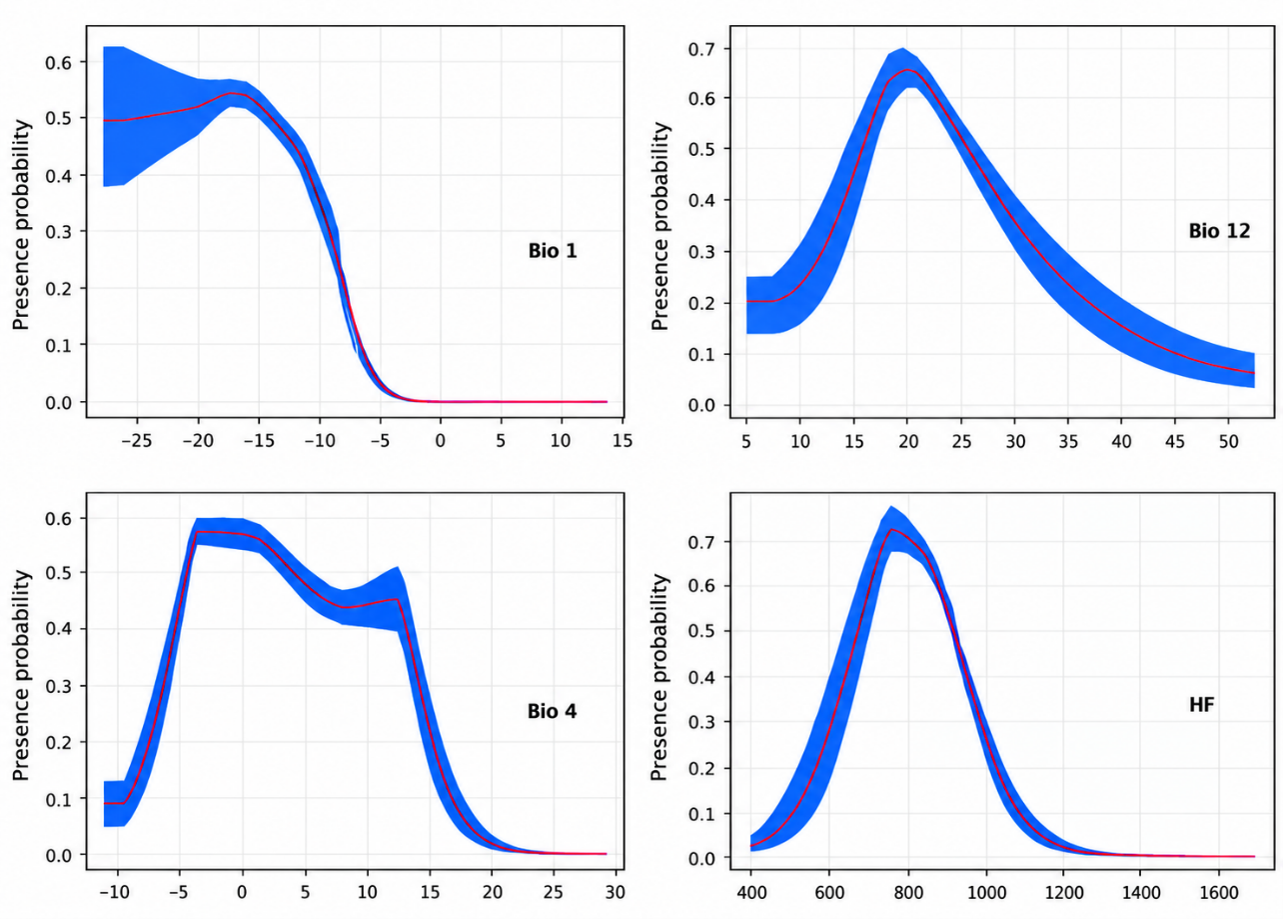
Climate change is expected to alter the distribution and persistence of freshwater fishes, particularly endemic species with geographically restricted ranges. An ensemble species distribution modelling (SDM) framework implemented in biomod2 to estimate current habitat suitability for the vulnerable yellowfin barbel (Luciobarbus xanthopterus) and to project changes under future climate scenarios. After spatial filtering, 42 occurrence records were retained. Nineteen bioclimatic variables, elevation, and human footprint were initially considered; after reducing multicollinearity, six predictors were retained: annual mean temperature, annual precipitation, temperature seasonality, precipitation of the wettest quarter, elevation, and human footprint. Six algorithms (ANN, RF, GLM, GBM, FDA, and MARS) were fitted and evaluated using AUC, TSS, and Cohen’s kappa. The ensemble model identified approximately 68,000km² of currently suitable habitat, corresponding to about 40% of the Iranian portion of the Tigris basin. Under SSP1-2.6, SSP2-4.5, SSP3-7.0, and SSP5-8.5 (low, intermediate, high, and very high greenhouse gas emissions, respectively), projected habitat loss by 2070 was 24%, 25%, 33%, and 49%, respectively, whereas habitat gains were 15%, 14%, 8%, and 5%. Net habitat change ranged from -9% under SSP1-2.6 to -44% under SSP5-8.5. Annual mean temperature, annual precipitation, temperature seasonality, and human footprint were the most influential predictors. These results indicate that climate change may substantially reduce the suitable range of L. xanthopterus and highlight the value of identifying climate refugia, maintaining river connectivity, and reducing non-climatic pressures in the Tigris–Euphrates system.
Keywords
Article Details

This work is licensed under a Creative Commons Attribution-NonCommercial-NoDerivatives 4.0 International License.
The authors transfer the copyrights of their papers to the Iranian Society of Ichthyology. However, the information could be used in accordance with the Creative Commons licence (Attribution-NonCommercial 4.0 International (CC BY-NC 4.0)
References
- Aiello-Lammens, M.E.; Boria, R.A.; Radosavljevic, A.; Vilela, B. & Anderson, R.P. 2015. spThin: An R package for spatial thinning of species occurrence records for use in ecological niche models. Ecography 38(5): 541-545.
- Beck, J.; Böller, M.; Erhardt, A.; & Schwanghart, W. 2014. Spatial bias in the GBIF database and its effect on modeling species' geographic distributions. Ecological Informatics 19: 10–15.
- Bonacina, L.; Fasano, F.; Mezzanotte, V. & Fornaroli, R. 2023. Effects of water temperature on freshwater macroinvertebrates: a systematic review. Biological Reviews 98(1): 191-221.
- Buisson, L.; Thuiller, W.; Lek, S.; Lim, P.U.Y. & Grenouillet, G. 2008. Climate change hastens the turnover of stream fish assemblages. Global Change Biology 14(10): 2232-2248.
- Çiçek, E.; Jawad, J.; Eagderi, S.; Esmaeili, H.R.; Mouludi-Saleh, A.; Sungur, S. & Fricke, R. 2023. Freshwater fishes of Iraq: a revised and updated annotated checklist—2023. Zootaxa 5357(1): 001-049.
- Darab, M.; Mostafavi, H.; Rahimi, R.; Teimori, A. & Farshchi, P. 2020. Modeling the habitat suitability of Botak-e-Fars, Cyprinion tenuiradius Heckel, 1849 and determining the impact of climate change on its distribution in Fars Province. Journal of Applied Ichthyological Research 8(5): 51-60.
- Eagderi, S.; Mouludi-Saleh, A.; Esmaeili, H.R.; Sayyadzadeh, G. & Nasri, M. 2022. Freshwater lamprey and fishes of Iran; a revised and updated annotated checklist—2022. Turkish Journal of Zoology 46(6): 500-522.
- Fick, S.E.; & Hijmans, R.J. 2017. WorldClim 2: New 1-km spatial resolution climate surfaces for global land areas. International Journal of Climatology 37(12): 4302-4315.
- Freyhof, J. 2014. Luciobarbus xanthopterus. The IUCN Red List of Threatened Species 2014: e.T19383627A19849886. https://dx.doi.org/10.2305/IUCN.UK.2014-1.RLTS.T19383627A19849886.en. Accessed on 16 October 2026.
- Harris, J.; Pirtle, J.L.; Laman, E.A.; Siple, M.C. & Thorson, J.T. 2024. An ensemble approach to species distribution modelling reconciles systematic differences in estimates of habitat utilization and range area. Journal of Applied Ecology 61(2): 351-364.
- Hussain, N. A.; Saoud, H. A.; & Al Shami, E. J. 2008. Species composition and ecological indices of fishes in the restored marshes of southern Mesopotamia. Marsh Bulletin 3(1): 17-31.
- Jouladeh-Roudbar, A.; Ghanavi, H. & Doadrio, I. 2020. Ichthyofauna from Iranian freshwater: annotated checklist, diagnosis, taxonomy, distribution and conservation assessment. Zoological Studies 59: 21.
- Keivany, Y.; Nasri, M.; Abbasi, K. & Abdoli, A. 2016. Fishes of Iran. Atlas of inland water fishes of Iran. Department of Environment, Tehran, Iran.
- Khoshnamvand, H.; Mousavi, S.M.; Darvishi, A.; Ahmadi, K.; Naghibi, A.; Janko, K.; Abdoli, A. & Ahmadzadeh, F. 2025. Macroecological predictors to determine future refuges of Luciobarbus species in the Tigris–Euphrates basin: Rethinking conservation strategies and management. Global Ecology and Conservation 57: e03394.
- Makki, T.; Mostafavi, H. Matkan, A. & Aghighi, H. 2021. Modelling climate-change impact on the spatial distribution of Garra rufa (Heckel, 1843) (Teleostei: Cyprinidae). Iranian Journal of Science and Technology, Transactions A: Science 45(3): 795-804.
- Makki, T.; Mostafavi, H.; Matkan, A.A.; Valavi, R.; Hughes, R.M.; Shadloo, S.; Aghighi, H.; Abdoli, A.; Teimori, A.; Eagderi, S. & Coad, B.W. 2023. Predicting climate heating impacts on riverine fish species diversity in a biodiversity hotspot region. Scientific Reports 13: 14347.
- Masoumi, A.H.; Esmaeili, H.R.; Khosravi, R.; Gholamhosseini, A.; Korkmaz, M. & Jeppesen, E. 2024. Species on the move: Impacts of climate change on the spatial range of endemic fishes of the eco-sensitive semi-arid area of the Arabian Peninsula. Science of the Total Environment 947: 174095.
- McComb, B.C. & Cushman, S.A. 2020. Synergistic effects of pervasive stressors on ecosystems and biodiversity. Frontiers in Ecology and Evolution 8: 569997.
- Moghadam, H. & Kambouzia, J. 2021. The ecology and modelling of the freshwater ecosystems in Iran. In L.A. Jawad (Ed.), Tigris and Euphrates Rivers: Their environment from headwaters to mouth (pp. 1143-1200). Springer.
- Mostafavi, H.; Mehrabian, A. R.; Teimori, A.; Shafizade-Moghadam, H. & Kambouzia, J. 2021. The ecology and modelling of the freshwater ecosystems in Iran. In Tigris and Euphrates Rivers: Their environment from headwaters to mouth (pp. 1143-1200). Cham: Springer International Publishing.
- Pavey, C.R.; Addison, J.; Brandle, R.; Dickman, C.R.; McDonald, P.J.; Moseby, K.E. & Young, L.I. 2017. The role of refuges in the persistence of Australian dryland mammals. Biological Reviews 92(2): 647-664.
- Reid, A.J.; Carlson, A.K.; Creed, I.F.; Eliason, E.J.; Gell, P.A.; Johnson, P.T.J.; Kidd, K.A.; MacCormack, T.J.; Olden, J.D.; Ormerod, S.J.; Smol, J.P.; Taylor, W.W.; Tockner, K.; Vermaire, J.C.; Dudgeon, D. & Cooke, S.J. 2019. Emerging threats and persistent conservation challenges for freshwater biodiversity. Biological Reviews 94(3): 849-873.
- Rezaei, M.; Pazira, A.; Teimori, A. & Amiri, F. 2024. Modeling the impacts of climate change on the distribution of the song fish Luciobarbus esocinus Heckel, 1843 under various climate scenarios. Advanced Environmental Sciences 22(2): 197-210.
- Sanderson, E.W.; Jaiteh, M.; Levy, M.A.; Redford, K.H.; Wannebo, A.V. & Woolmer, G. 2002. The human footprint and the last of the wild. BioScience 52(10): 891-904.
- Sayyadzadeh, G. & Esmaeili, H.R. 2024. Freshwater lamprey and fishes of Iran: reappraisal and updated checklist with a note on Eagderi et al. (2022). Zootaxa 5402(1): 1-99.
- Steen, V.A.; Tingley, M.W.; Paton, P.W. & Elphick, C.S. 2021. Spatial thinning and class balancing: Key choices lead to variation in the performance of species distribution models with citizen science data. Methods in Ecology and Evolution 12(2): 216-226.
- Thuiller, W.; Guéguen, M.; Renaud, J.; Karger, D.N. & Zimmermann, N.E. 2019. Uncertainty in ensembles of global biodiversity scenarios. Nature Communications 10(1): 1446.
- Thuiller, W.; Lafourcade, B.; Engler, R. & Araújo, M.B. 2009. BIOMOD—a platform for ensemble forecasting of species distributions. Ecography 32(3): 369-373.
- Thuiller, W.; Lafourcade, B.; Engler, R. & Araújo, M.B. 2009. BIOMOD – a platform for ensemble forecasting of species distributions. Ecography 32(3): 369-373.
- van Proosdij, A.S.J.; Sosef, M.S.M.; Wieringa, J.J. & Raes, N. 2016. Minimum required number of specimen records to develop accurate species distribution models. Ecography 39(6): 542-552. https://doi.org/10.1111/ecog.01509
- Van Rees, C.B.; Waylen, K.A.; Schmidt-Kloiber, A.; Thackeray, S.J.; Kalinkat, G.; Martens, K.; Domisch, S.; Lillebø, A.I., Hermoso, V., Grossart, H., Schinegger, R., Decleer, K., Adriaens, T., Denys, L., Jarić, I., Janse, J. H., Monaghan, M.T.; De Wever, A.; Geijzendorffer, I. & Jähnig, S.C. 2021. Safeguarding freshwater life beyond 2020: Recommendations for the new global biodiversity framework from the European experience. Conservation Letters 14(1): e12771.
- Whitfield, A.K.; Gillanders, B.M. & Able, K.W. 2023. Climate change effects on fish populations. In Climate change and estuaries (pp. 475-506). CRC Press.
References
Aiello-Lammens, M.E.; Boria, R.A.; Radosavljevic, A.; Vilela, B. & Anderson, R.P. 2015. spThin: An R package for spatial thinning of species occurrence records for use in ecological niche models. Ecography 38(5): 541-545.
Beck, J.; Böller, M.; Erhardt, A.; & Schwanghart, W. 2014. Spatial bias in the GBIF database and its effect on modeling species' geographic distributions. Ecological Informatics 19: 10–15.
Bonacina, L.; Fasano, F.; Mezzanotte, V. & Fornaroli, R. 2023. Effects of water temperature on freshwater macroinvertebrates: a systematic review. Biological Reviews 98(1): 191-221.
Buisson, L.; Thuiller, W.; Lek, S.; Lim, P.U.Y. & Grenouillet, G. 2008. Climate change hastens the turnover of stream fish assemblages. Global Change Biology 14(10): 2232-2248.
Çiçek, E.; Jawad, J.; Eagderi, S.; Esmaeili, H.R.; Mouludi-Saleh, A.; Sungur, S. & Fricke, R. 2023. Freshwater fishes of Iraq: a revised and updated annotated checklist—2023. Zootaxa 5357(1): 001-049.
Darab, M.; Mostafavi, H.; Rahimi, R.; Teimori, A. & Farshchi, P. 2020. Modeling the habitat suitability of Botak-e-Fars, Cyprinion tenuiradius Heckel, 1849 and determining the impact of climate change on its distribution in Fars Province. Journal of Applied Ichthyological Research 8(5): 51-60.
Eagderi, S.; Mouludi-Saleh, A.; Esmaeili, H.R.; Sayyadzadeh, G. & Nasri, M. 2022. Freshwater lamprey and fishes of Iran; a revised and updated annotated checklist—2022. Turkish Journal of Zoology 46(6): 500-522.
Fick, S.E.; & Hijmans, R.J. 2017. WorldClim 2: New 1-km spatial resolution climate surfaces for global land areas. International Journal of Climatology 37(12): 4302-4315.
Freyhof, J. 2014. Luciobarbus xanthopterus. The IUCN Red List of Threatened Species 2014: e.T19383627A19849886. https://dx.doi.org/10.2305/IUCN.UK.2014-1.RLTS.T19383627A19849886.en. Accessed on 16 October 2026.
Harris, J.; Pirtle, J.L.; Laman, E.A.; Siple, M.C. & Thorson, J.T. 2024. An ensemble approach to species distribution modelling reconciles systematic differences in estimates of habitat utilization and range area. Journal of Applied Ecology 61(2): 351-364.
Hussain, N. A.; Saoud, H. A.; & Al Shami, E. J. 2008. Species composition and ecological indices of fishes in the restored marshes of southern Mesopotamia. Marsh Bulletin 3(1): 17-31.
Jouladeh-Roudbar, A.; Ghanavi, H. & Doadrio, I. 2020. Ichthyofauna from Iranian freshwater: annotated checklist, diagnosis, taxonomy, distribution and conservation assessment. Zoological Studies 59: 21.
Keivany, Y.; Nasri, M.; Abbasi, K. & Abdoli, A. 2016. Fishes of Iran. Atlas of inland water fishes of Iran. Department of Environment, Tehran, Iran.
Khoshnamvand, H.; Mousavi, S.M.; Darvishi, A.; Ahmadi, K.; Naghibi, A.; Janko, K.; Abdoli, A. & Ahmadzadeh, F. 2025. Macroecological predictors to determine future refuges of Luciobarbus species in the Tigris–Euphrates basin: Rethinking conservation strategies and management. Global Ecology and Conservation 57: e03394.
Makki, T.; Mostafavi, H. Matkan, A. & Aghighi, H. 2021. Modelling climate-change impact on the spatial distribution of Garra rufa (Heckel, 1843) (Teleostei: Cyprinidae). Iranian Journal of Science and Technology, Transactions A: Science 45(3): 795-804.
Makki, T.; Mostafavi, H.; Matkan, A.A.; Valavi, R.; Hughes, R.M.; Shadloo, S.; Aghighi, H.; Abdoli, A.; Teimori, A.; Eagderi, S. & Coad, B.W. 2023. Predicting climate heating impacts on riverine fish species diversity in a biodiversity hotspot region. Scientific Reports 13: 14347.
Masoumi, A.H.; Esmaeili, H.R.; Khosravi, R.; Gholamhosseini, A.; Korkmaz, M. & Jeppesen, E. 2024. Species on the move: Impacts of climate change on the spatial range of endemic fishes of the eco-sensitive semi-arid area of the Arabian Peninsula. Science of the Total Environment 947: 174095.
McComb, B.C. & Cushman, S.A. 2020. Synergistic effects of pervasive stressors on ecosystems and biodiversity. Frontiers in Ecology and Evolution 8: 569997.
Moghadam, H. & Kambouzia, J. 2021. The ecology and modelling of the freshwater ecosystems in Iran. In L.A. Jawad (Ed.), Tigris and Euphrates Rivers: Their environment from headwaters to mouth (pp. 1143-1200). Springer.
Mostafavi, H.; Mehrabian, A. R.; Teimori, A.; Shafizade-Moghadam, H. & Kambouzia, J. 2021. The ecology and modelling of the freshwater ecosystems in Iran. In Tigris and Euphrates Rivers: Their environment from headwaters to mouth (pp. 1143-1200). Cham: Springer International Publishing.
Pavey, C.R.; Addison, J.; Brandle, R.; Dickman, C.R.; McDonald, P.J.; Moseby, K.E. & Young, L.I. 2017. The role of refuges in the persistence of Australian dryland mammals. Biological Reviews 92(2): 647-664.
Reid, A.J.; Carlson, A.K.; Creed, I.F.; Eliason, E.J.; Gell, P.A.; Johnson, P.T.J.; Kidd, K.A.; MacCormack, T.J.; Olden, J.D.; Ormerod, S.J.; Smol, J.P.; Taylor, W.W.; Tockner, K.; Vermaire, J.C.; Dudgeon, D. & Cooke, S.J. 2019. Emerging threats and persistent conservation challenges for freshwater biodiversity. Biological Reviews 94(3): 849-873.
Rezaei, M.; Pazira, A.; Teimori, A. & Amiri, F. 2024. Modeling the impacts of climate change on the distribution of the song fish Luciobarbus esocinus Heckel, 1843 under various climate scenarios. Advanced Environmental Sciences 22(2): 197-210.
Sanderson, E.W.; Jaiteh, M.; Levy, M.A.; Redford, K.H.; Wannebo, A.V. & Woolmer, G. 2002. The human footprint and the last of the wild. BioScience 52(10): 891-904.
Sayyadzadeh, G. & Esmaeili, H.R. 2024. Freshwater lamprey and fishes of Iran: reappraisal and updated checklist with a note on Eagderi et al. (2022). Zootaxa 5402(1): 1-99.
Steen, V.A.; Tingley, M.W.; Paton, P.W. & Elphick, C.S. 2021. Spatial thinning and class balancing: Key choices lead to variation in the performance of species distribution models with citizen science data. Methods in Ecology and Evolution 12(2): 216-226.
Thuiller, W.; Guéguen, M.; Renaud, J.; Karger, D.N. & Zimmermann, N.E. 2019. Uncertainty in ensembles of global biodiversity scenarios. Nature Communications 10(1): 1446.
Thuiller, W.; Lafourcade, B.; Engler, R. & Araújo, M.B. 2009. BIOMOD—a platform for ensemble forecasting of species distributions. Ecography 32(3): 369-373.
Thuiller, W.; Lafourcade, B.; Engler, R. & Araújo, M.B. 2009. BIOMOD – a platform for ensemble forecasting of species distributions. Ecography 32(3): 369-373.
van Proosdij, A.S.J.; Sosef, M.S.M.; Wieringa, J.J. & Raes, N. 2016. Minimum required number of specimen records to develop accurate species distribution models. Ecography 39(6): 542-552. https://doi.org/10.1111/ecog.01509
Van Rees, C.B.; Waylen, K.A.; Schmidt-Kloiber, A.; Thackeray, S.J.; Kalinkat, G.; Martens, K.; Domisch, S.; Lillebø, A.I., Hermoso, V., Grossart, H., Schinegger, R., Decleer, K., Adriaens, T., Denys, L., Jarić, I., Janse, J. H., Monaghan, M.T.; De Wever, A.; Geijzendorffer, I. & Jähnig, S.C. 2021. Safeguarding freshwater life beyond 2020: Recommendations for the new global biodiversity framework from the European experience. Conservation Letters 14(1): e12771.
Whitfield, A.K.; Gillanders, B.M. & Able, K.W. 2023. Climate change effects on fish populations. In Climate change and estuaries (pp. 475-506). CRC Press.